
“Every housewife who plans a meal so that each part of the menu is completed at the same time is using the basic technique of PERT.”
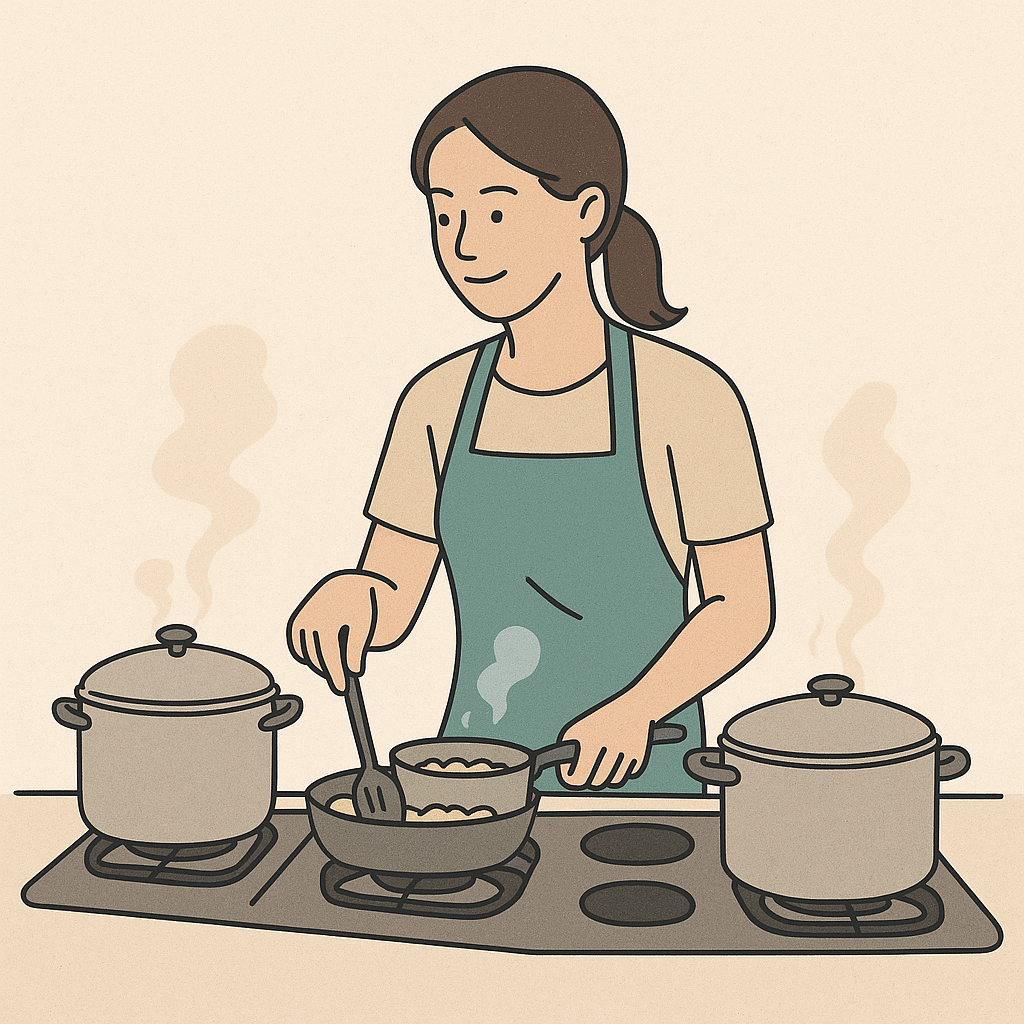
Step 1. What is happening here?
A housewife is planning a multi-step process —
cooking rice, dal, vegetables, roti, dessert —
so that all are ready together at lunchtime.
- Some dishes take longer (dal needs soaking + boiling).
- Some are quick (chapatis just before serving).
- Some can be made early (dessert).
All these tasks need to be sequenced, timed, and coordinated.
Step 2. Why does this match PERT?
Because in this situation:
- The exact time each dish takes may vary daily — depends on stove heat, quantity, help available, etc.
- The cook has to make time estimates (how long each item probably takes).
- Tasks are interdependent — e.g., can’t season dal before it’s boiled.
- The goal is to ensure everything finishes together despite uncertainty.
➡️ That is exactly what PERT does:
It’s used when time is uncertain and you need to plan and coordinate multiple dependent tasks logically to achieve a common goal.
Step 3. Why it is not CPM
CPM (Critical Path Method) is used when:
- Task times are known from experience.
- The focus is on optimizing time and cost — like in an industrial or construction project.
But in cooking:
- You don’t have precise, fixed durations.
- You can’t calculate cost–time trade-offs.
- You just want to plan so everything is ready together, even if the timings vary slightly.
So, the uncertainty factor → makes it PERT, not CPM.
In short:
| Feature | PERT (Meal Example) | CPM |
|---|---|---|
| Time certainty | Variable (depends on conditions) | Fixed & known |
| Focus | Coordination of uncertain tasks | Optimization of time and cost |
| Type of project | Daily, flexible process | Repetitive, structured project |
| Example | Cooking multiple dishes together | Building a hospital wing (known durations) |
🧠 Easy memory tip:
PERT = Planning with Probabilities
CPM = Controlling with Certainties
The meal-planning example represents PERT because the time for each task is uncertain, and the focus is on coordinating multiple interdependent activities to finish simultaneously — not on optimizing time or cost as in CPM.
STILL CONFUSED
“If CPM is used for routine projects where timings are known…
then the housewife cooking a meal every day also sounds routine, right?
So why is that example called PERT and not CPM?”
Excellent point.
Now let’s unpack this carefully. 👇
Step 1 — The Meaning of “Routine” in CPM
When we say routine project in CPM, we don’t mean “a daily routine activity” like cooking.
We mean a project where the duration of each activity is known and measurable with accuracy — because it’s been done before under controlled, standard conditions.
✅ Example:
- Building a hospital block: the engineer knows exactly how many days each stage takes — foundation (10 days), walls (20 days), roofing (7 days), etc.
- Conducting annual immunization: the team already knows time per round, manpower needed, costs, and sequence.
👉 So, “routine” here = standardized and predictable — not “daily life routine.”
Step 2 — Why the Housewife Example Is Still PERT
Even though the housewife cooks often, each cooking session isn’t identical — the timing changes daily:
- Maybe the stove burns hotter today.
- Maybe she’s cooking for guests (more quantity).
- Maybe vegetables take longer to soften.
- Maybe one helper is absent.
⏱️ The time of each task is not fixed — it’s estimated.
She mentally plans — “the dal usually takes 20 minutes, but today maybe 25” — that’s a probabilistic (estimated) approach.
Hence, it becomes PERT, because the time for each activity is not certain — it’s variable and depends on conditions.
Step 3 — Key Difference Simplified
| Concept | PERT | CPM |
|---|---|---|
| Project type | Time uncertain | Time known |
| Based on | Probabilities / Estimates | Experience / Records |
| Real-life feel | “I’ll plan based on how long it might take.” | “I know exactly how long it will take.” |
| Example | Cooking a meal (uncertain durations) | Constructing a hospital (known durations) |
🧠 In short:
- “Routine” in CPM means standardized, predictable project with measured timing — not just something you do daily.
- The housewife’s cooking involves uncertain, estimated times — so it fits PERT.
🎯 The Golden Line to Remember:
PERT = When you estimate how long tasks might take.
CPM = When you know how long tasks will take.