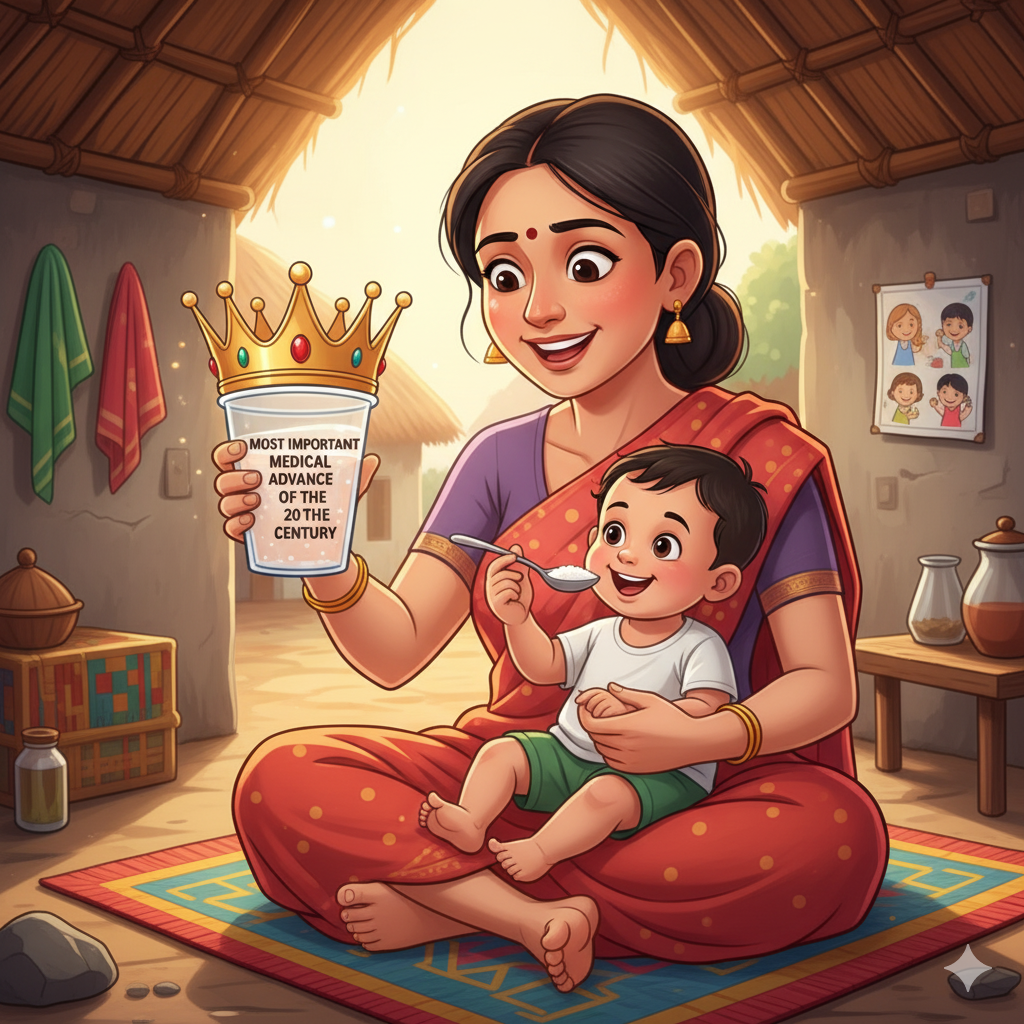
This story is about how a tiny scientific secret and a lot of courage transformed global health. By the end of this story, you will understand:
What ORS (Oral Rehydration Solution) is and why it’s so powerful.
The life-saving physiological principle that made it possible.
The real heroes — especially from India — who turned a laboratory idea into a worldwide revolution.
How ORS became the most impactful medical discovery of the 20th century.
A Crisis in 1960 — The Turning Point of Despair
Imagine stepping into a small, overcrowded hospital in Dhaka in the early 1960s. The smell of disinfectant mixes with fear. The monsoon humidity clings to your skin.
A cholera epidemic has struck — swift, merciless, and deadly.
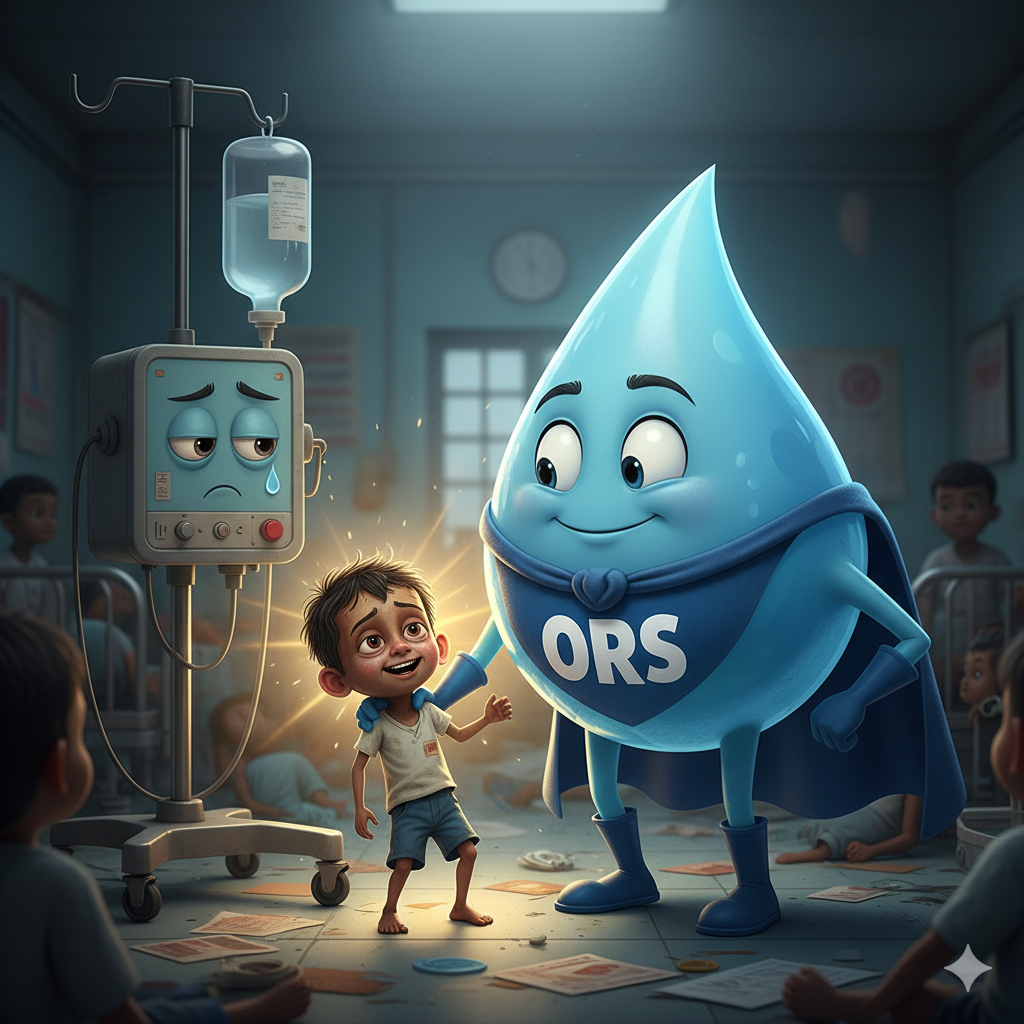
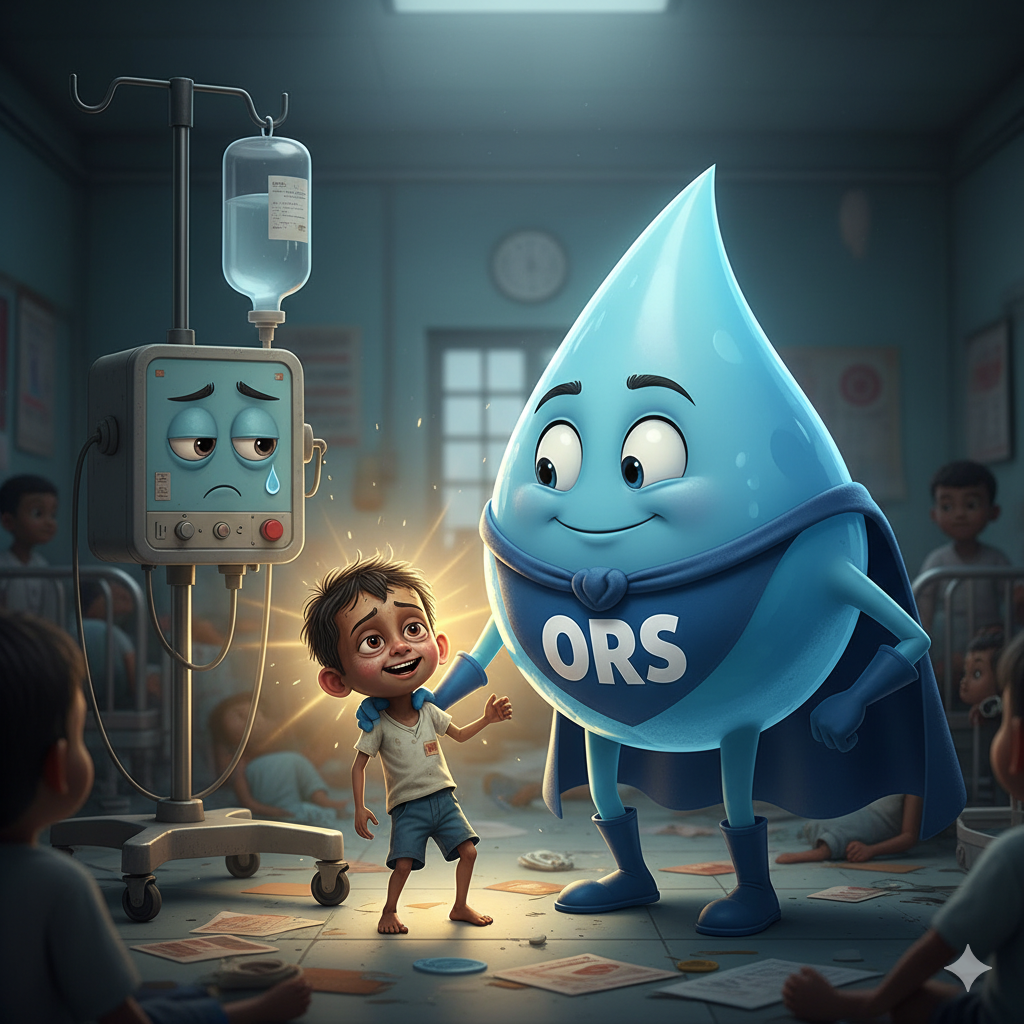
The hospital corridors are lined with weak, lifeless bodies. Children lie on the floor with sunken eyes, dry lips, and limp limbs. Their mothers fan them helplessly. The children cry without tears — their bodies so drained that even tears have abandoned them.
Doctors and nurses rush around in panic. They know the cause — severe dehydration from continuous, watery diarrhea — but the treatment, IV saline, is running out.
In the chaos, IV bottles are scarce, trained staff even scarcer. And in remote villages, there are no bottles, no nurses, no doctors — only despair.
The death toll climbs.
In this storm of hopelessness, a few scientists begin to ask what sounds like a crazy question:
“What if we could replace all this water without using a needle? What if the solution lies not in hospitals, but in the human gut itself?”
That question would go on to save more lives than any vaccine, antibiotic, or operation ever did.
💧 The Scientific Miracle in a Packet — What Exactly Is ORS?
ORS stands for Oral Rehydration Solution — a simple, precise mixture of:
Salt (Sodium Chloride)
Sugar (Glucose)
Potassium Chloride
Citrate (or Bicarbonate)
Dissolved in one liter of clean water.
That’s it. No fancy ingredients, no technology. Yet it became the world’s most effective life-saving therapy.
But how can salt and sugar save a dying person?
🔬 The Secret Behind ORS — A Triumph of Physiology
In the late 1950s, scientists were studying how nutrients are absorbed in the small intestine.
A physiologist named Dr. Robert K. Crane made a revolutionary discovery:
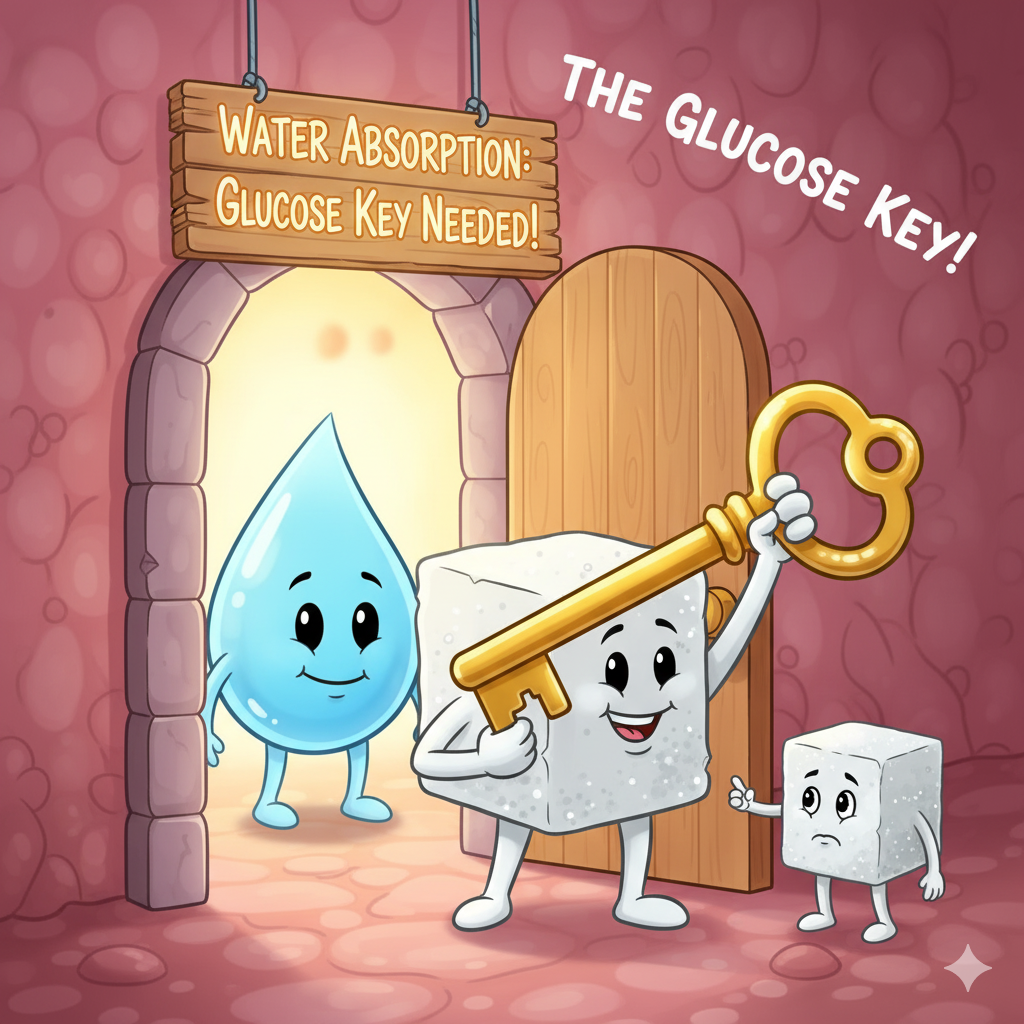
The small intestine has a co-transport mechanism — it absorbs sodium and glucose together.
When both are present in the gut, glucose acts like a key that opens a special “pump” in the intestinal wall. This pump pulls sodium — and water — directly into the bloodstream.
💬 In simple words: When salt and sugar are given together, the intestine absorbs water efficiently — even when the person is still losing fluids through diarrhea.
This tiny discovery in a lab would become the foundation for one of the greatest public health victories in human history.
The Dhaka Trials — From Theory to Real Life
The theory was there. Now it needed proof.
In the 1960s, researchers at the Cholera Research Laboratory in Dhaka (now ICDDR,B) — including Dr. David Nalin, Dr. Richard Cash, and Dr. Norbert Hirschhorn — began small experiments using this idea.
They gave cholera patients a glucose-salt solution to drink, even while diarrhea continued.
To their astonishment — the patients did not dehydrate. They continued to lose fluid through stools, yes, but their bodies absorbed enough through the intestines to survive and recover.
💬 For the first time in human history, people could survive cholera without an IV drip.
But this was still in hospital settings. Would it work in the real world — in crowded, poor, epidemic-hit areas?
That answer came from India.
The Indian Hero — Dr. Dilip Mahalanabis and the Refugee Camps
In 1971, as the Bangladesh Liberation War raged, millions of refugees fled into India. Makeshift camps in Bangaon, West Bengal, were overwhelmed. Cholera and dysentery spread like wildfire.
Dr. Dilip Mahalanabis, a young Indian pediatrician from Kolkata working with the Johns Hopkins–ICDDR,B team, found himself at the center of this disaster.
IV fluids ran out. Trained personnel were exhausted. Patients were dying by the hundreds.
Faced with this impossible situation, Dr. Mahalanabis took a decision that defied all medical norms at the time.
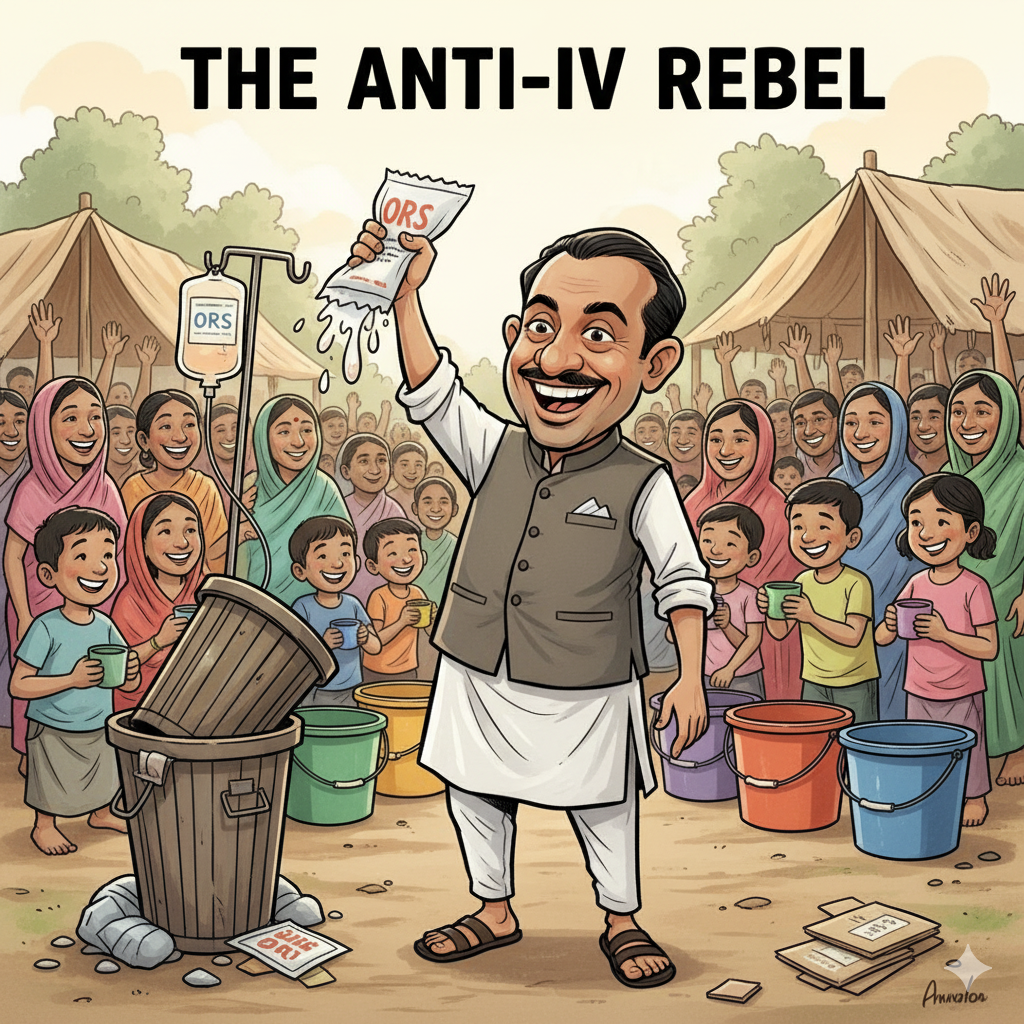
He decided to abandon IV therapy and use only the simple salt-sugar solution — ORS — given by mouth.
They mixed large quantities of the solution in buckets and drums, and family members were instructed to feed it continuously to the patients using cups, mugs, or even spoons.
Within days, death rates plummeted.
Before ORS: 30% of patients died.
After ORS: Only 3–4% did.
It was an unimaginable success — achieved without electricity, equipment, or even hospitals.
Dr. Mahalanabis’s courage turned a scientific idea into a humanitarian miracle.
He later said humbly:
“It was not my discovery. It was the people — the mothers and fathers — who made it work.”
From Camps to the World — ORS Becomes a Global Hero
The refugee camp success caught the attention of global health authorities.
By 1978, the World Health Organization (WHO) and UNICEF officially adopted Oral Rehydration Therapy (ORT) as the cornerstone of diarrhea treatment worldwide.
The medical journal The Lancet called it:
“Potentially the most important medical advance of the 20th century.”
💬 A Simple Mantra for Every Mother:
“A pinch of salt, a handful of sugar, and a liter of clean water.”
This line became the world’s most powerful health education tool. It could be taught in any language, to anyone — and it worked.
⚗️ Evolution of ORS Formulas
As years passed, scientists refined the formula:
Period
Formula
Sodium (mmol/L)
Special Note
1970s
Standard WHO ORS
90
Ideal for cholera, high sodium
2002 onwards
Low Osmolarity ORS
75
Better for children — less stool, less vomiting
Home-made ORS
Salt + Sugar + Water
~75
Easy, immediate, life-saving
Today, ORS packets are everywhere — in every health center, school, and home.
📈 The Global Impact
The numbers speak louder than words:
Child deaths from diarrhea dropped by over 90% globally since the 1970s.
ORS is estimated to save 1–2 million lives every year.
It’s part of every country’s essential medicines list.
No complex machines, no high cost — just education, awareness, and access.
ORS became a symbol of equity in healthcare — a treatment that the richest and the poorest could both use.
India’s Continued Leadership
India didn’t just pioneer ORS use; it sustained it.
National Diarrheal Disease Control Programme (1980s): Made ORS sachets part of every PHC.
ASHA and ANM training: Every frontline worker learns how to make and teach ORS preparation.
Community campaigns: Mothers’ meetings, school health programs, and radio messages made ORS a household name.
Today, India produces over 1 billion ORS packets annually.
Dr. Mahalanabis was later nominated for the Nobel Prize, and his work remains a shining chapter in Indian public health history.
Lessons from the ORS Story
Lesson
Meaning
1. Science doesn’t have to be complicated
Even basic physiology can change the world.
2. Courage matters as much as discovery
Dr. Mahalanabis dared to do what others feared.
3. Health belongs to people
Families, not hospitals, became the true healers.
4. Prevention and education save more lives
Teaching mothers was as powerful as any medicine.
In Retrospect
From crowded refugee camps to global recognition, the story of ORS is not just medical history — it’s human history.
It showed that simple, evidence-based, community-driven solutions can defeat the biggest killers of the poor.
ORS did not just rehydrate bodies — it rehydrated hope. 💧
💬 Let’s See How Much You Learnt
Question: During a severe diarrhea outbreak in a remote area, health workers have no IV fluids but plenty of clean water, sugar, and salt. They train families to prepare and give a salt-sugar drink continuously. 👉 Which medical principle are they using, and which global innovation does this represent?
Answer: ✅ They are applying the sodium-glucose co-transport mechanism — the scientific basis of Oral Rehydration Therapy (ORT). This represents the life-saving innovation of ORS, first proven effective in India by Dr. Dilip Mahalanabis.
🌟 In Short
ORS is proof that the greatest revolutions in medicine don’t always come from laboratories — sometimes they come from courage, compassion, and a spoonful of sugar. 🍚💧