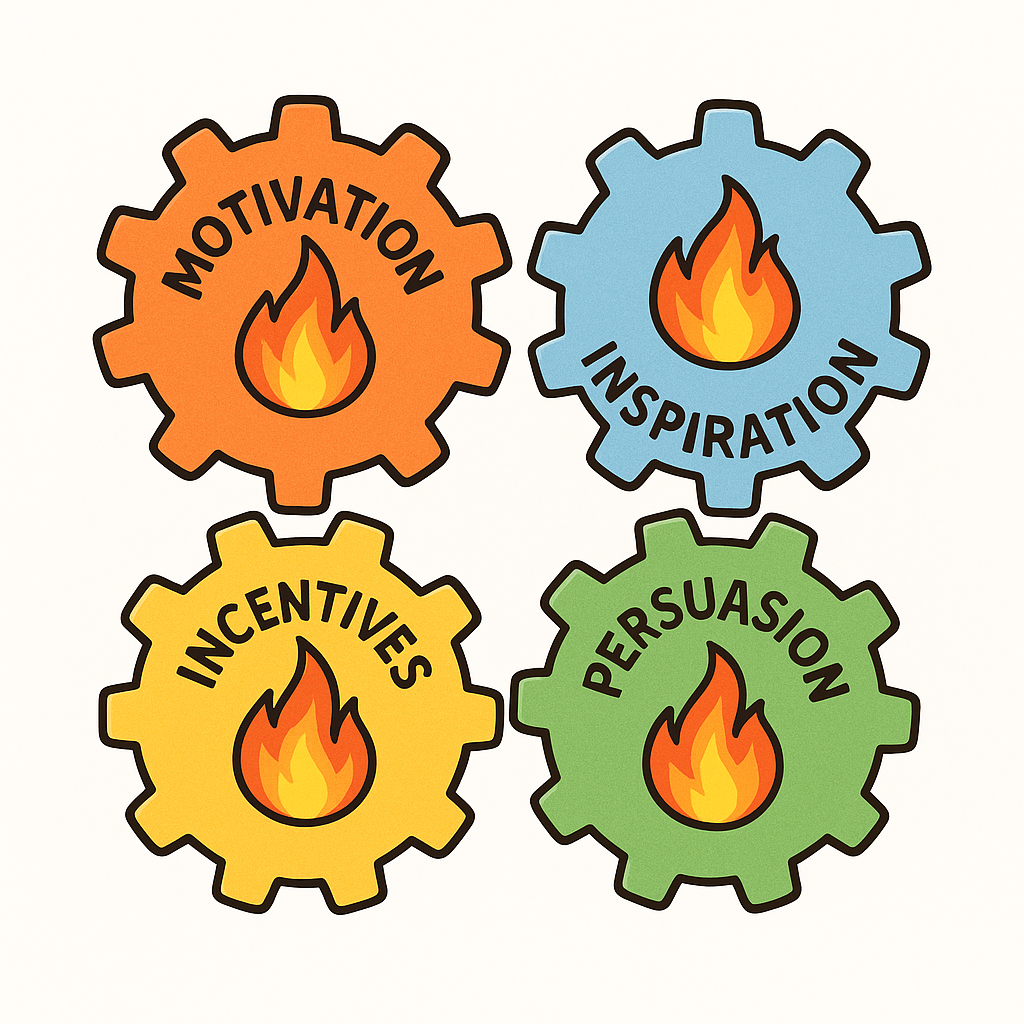
No health program, no campaign, no hospital system will ever succeed just because of planning.
Why? Because humans are not machines. You can’t simply command them to “do this” and expect it to work.
People act when something moves them — a thought, a feeling, a reason, or a reward.
That’s what these four forces are all about:
How to make people want to do something, not just have to do it.
🧠 1. MOTIVATION — The Fire Within
Let’s start with the simplest and strongest one — motivation.
🔥 What is Motivation?
Motivation is the inner drive that pushes a person to act toward a goal.
💬 It answers the question — “Why should I do this?”
Think of it as the fuel that makes people move. Without motivation, no engine — not even a human one — will start.
💡 Simple Example:
A nurse who checks every newborn’s temperature on time — not because someone is watching, but because she cares that no baby should suffer — that’s motivation.
Or, a student who studies community medicine not for marks, but to become a doctor who saves villages — that’s motivation.
🧩 In Health Programs:
Motivation is what makes ASHA workers walk miles in the heat. It’s what makes a doctor stay late in the ward. It’s what makes a mother follow immunization schedules — because she wants her child safe.
🧠 Key Point:
Motivation comes from within. It is emotional, personal, and self-driven.
💬 Formula: Motivation = Inner reason + Sense of purpose + Emotion.
💫 2. INSPIRATION — The Spark from Outside
If motivation is an inner fire, inspiration is the spark that lights it.
🌠 What is Inspiration?
Inspiration is when something outside you — a person, story, or event — awakens a powerful feeling inside you.
💬 It answers the question — “If they can do it, why can’t I?”
💡 Example:
When a doctor hears Dr. Dilip Mahalanabis’s story of ORS and feels, “I want to do something meaningful too.”
When a student watches a senior working in rural health camps and decides, “That’s what I want to become.”
That’s inspiration.
Inspiration often leads to motivation. It’s like a domino effect — a spark outside ignites a flame inside.
🧩 In Public Health:
A good health leader inspires others. When a village head gets vaccinated publicly, and everyone follows — that’s inspiration in action.
Now, not everyone will be inspired or motivated right away. That’s where persuasion comes in — the art and science of influencing people through logic, emotion, and communication.
💬 What is Persuasion?
Persuasion is when you change someone’s attitude or behavior through reasoning, trust, and connection — not force.
💡 Example:
When you convince a hesitant mother to vaccinate her baby by explaining the benefits calmly — you’re persuading.
When a health worker uses stories, pictures, or peer examples to change behavior — that’s persuasion.
💬 Important:
Persuasion is not manipulation. It’s not about tricking people — it’s about helping them see the truth more clearly.
🧩 In Health Programs:
Persuasion is the backbone of every IEC (Information, Education, Communication) campaign. Every poster, radio message, or street play — is persuasion in action.
💬 Formula: Persuasion = Logic + Emotion + Trust.
🎁 4. INCENTIVES — The Tangible Push
Sometimes, people need not just feelings — but a little nudge. That’s where incentives come in.
💰 What are Incentives?
Incentives are rewards or benefits given to encourage a desired behavior.
💬 It answers the question — “What will I gain if I do this?”
They can be:
Monetary: like cash for institutional deliveries under Janani Suraksha Yojana.
Non-monetary: like recognition, certificates, or appreciation in front of peers.
💡 Example:
ASHA workers get incentives for ensuring immunization coverage.
Students get medals for best performance — that’s an incentive too.
But remember:
Incentives may start a behavior — but only motivation sustains it.
That’s why smart health programs use incentives to begin change and motivation to maintain it.
Together, they form the engine of human behavior. 🚀
❤️ Why Every Health Worker Must Understand These
Because the success of every program — from vaccination to sanitation — depends not on money or materials, but on people’s willingness to act.
You can’t pour health into a community — you have to motivate, inspire, persuade, and sometimes reward them to take ownership.
💬 Application-Based Question
You are leading a campaign to increase toilet use in a rural area. You find that people are aware but still don’t use them. How will you apply motivation, inspiration, persuasion, and incentives to bring real change?
Answer Example: ✅
Inspiration: Show stories of nearby villages that achieved cleanliness.
Motivation: Help people realize the dignity and health benefits of having a toilet.
Persuasion: Use community meetings, demonstrations, and respected local figures to talk about hygiene.
Incentives: Provide awards to “Open Defecation Free” families or villages.
💡 When you combine all four, behavior change becomes natural — not forced.
🌟 In Short
Motivation is the flame, Inspiration is the spark, Persuasion is the breeze that makes it spread, Incentives are the gentle hands that fan it forward.
Together, they light the path to health, change, and leadership. 🌈