
🧠 After Reading This, You’ll Understand:
- What dietary fibre actually is (not just a “plant thing”)
- Types and sources of dietary fibre
- How it works inside the body
- Its role in preventing diseases
- How much fibre we really need — and why most of us don’t get enough
🌾 Let’s Begin with a Simple Thought
When you eat an apple 🍎, you probably think about its vitamins or sweetness.
But what happens to the part you can’t digest — the chewy, fibrous stuff?
That’s dietary fibre, and it’s not “waste.”
In fact, it’s one of the most powerful, underrated nutrients that keeps your gut clean, heart healthy, and metabolism balanced.
💬 Think of fibre as your body’s internal broom —
it sweeps through your digestive system, cleaning out cholesterol, sugars, and toxins as it goes.
🍞 What Exactly is Dietary Fibre?
By definition:
Dietary fibre is the part of plant foods that cannot be digested or absorbed in the human small intestine.
It passes into the large intestine (colon), where it either gets fermented by friendly bacteria or passes out — doing a lot of good along the way!
In simple words:
Fibre is the “non-digestible” part of plant food — but it’s what keeps your digestive system alive and thriving.
🍃 Animal foods contain no fibre.
Only plant-based foods — cereals, pulses, fruits, vegetables, and nuts — provide it.
🌿 Types of Dietary Fibre (Based on Solubility)
There are two main types — and both are essential.
| Type | Soluble Fibre | Insoluble Fibre |
|---|---|---|
| What it does | Dissolves in water, forms a gel | Doesn’t dissolve — adds bulk |
| Sources | Oats, barley, apples, citrus fruits, legumes | Wheat bran, brown rice, vegetables, nuts |
| Main Benefits | Lowers cholesterol, controls blood sugar | Prevents constipation, improves bowel movement |
💡 Tip to remember:
- Soluble = Soft & Sticky = Slows things down (like sugar & cholesterol)
- Insoluble = Rough & Rigid = Keeps things moving (your stool!)
🧬 What Happens to Fibre in the Body
Let’s follow fibre’s journey 👇
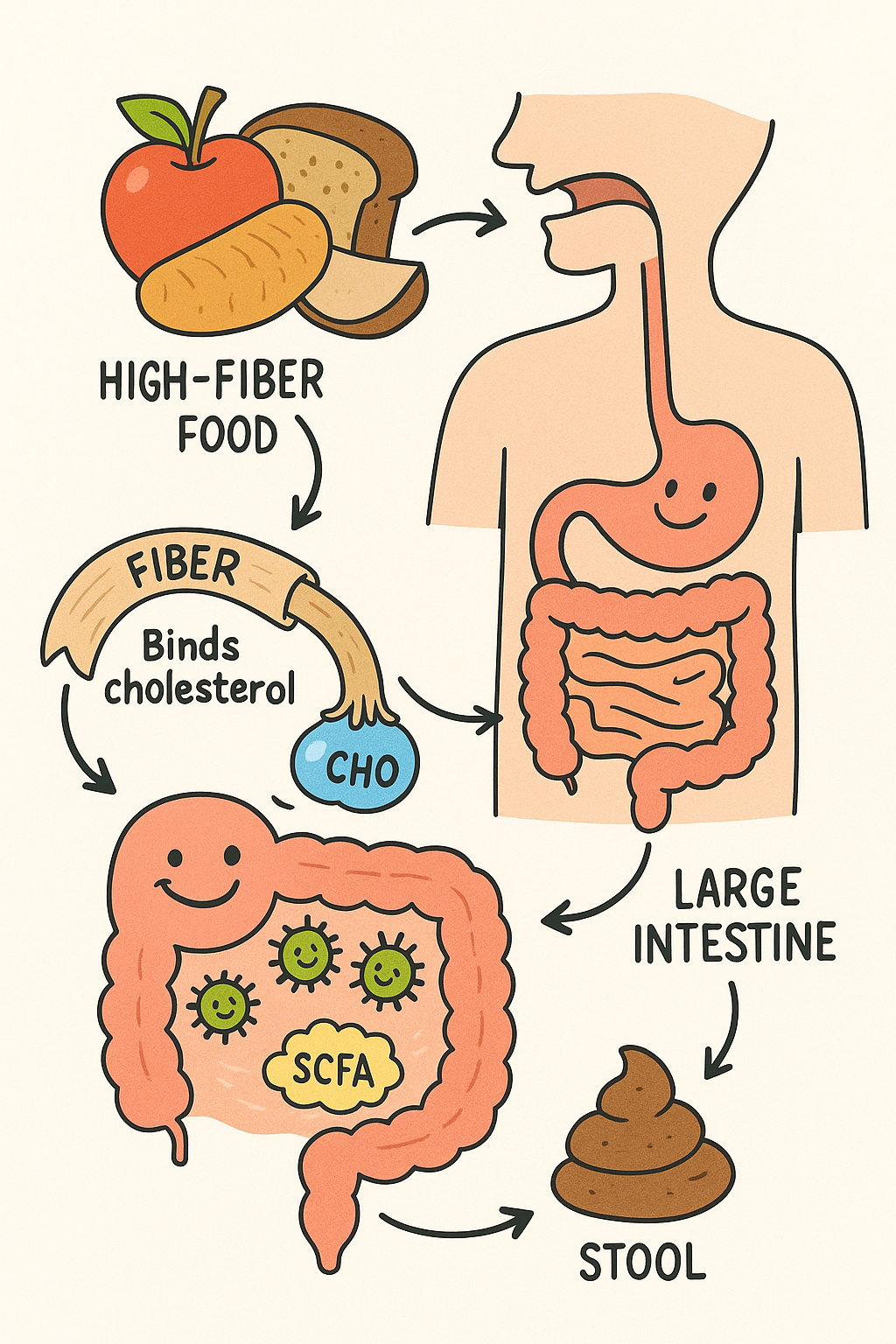
1️⃣ Mouth & Stomach:
Fibre resists digestion — no enzyme can break it down.
2️⃣ Small Intestine:
Still not digested! But soluble fibre starts forming a gel — slowing down sugar and fat absorption.
3️⃣ Large Intestine (Colon):
Here’s where the magic happens — bacteria feast on fibre, producing short-chain fatty acids (SCFAs) like butyrate.
These nourish colon cells and improve gut immunity.
💬 So, fibre doesn’t just pass through — it feeds your gut microbiome.
⚙️ Mechanism of Action — The Science Made Simple
Let’s decode how fibre works its magic 👇
💧 1. Binds Bile and Reduces Cholesterol
Bile salts (made from cholesterol) are trapped by soluble fibre and excreted.
This forces the liver to use more cholesterol to make new bile — lowering your total cholesterol levels naturally.
🍬 2. Controls Blood Sugar
By slowing digestion and glucose absorption, fibre prevents sudden sugar spikes after meals — reducing risk of diabetes.
🚽 3. Prevents Constipation
Insoluble fibre adds bulk and softness to stool, speeding up bowel movement.
💬 “A fibre-rich diet keeps your colon happy and your bathroom trips short!”
🌿 4. Feeds Good Gut Bacteria
Fibre is a prebiotic — food for probiotics (the good microbes).
Fermentation produces SCFAs which reduce inflammation and improve metabolism.
❤️ 5. Reduces Risk of Diseases
- Coronary heart disease 💓
- Type 2 diabetes 🩸
- Colon cancer 🦠
- Obesity ⚖️
🍛 Common Indian Sources of Fibre
| Food Group | Examples | Fibre (g/100g) |
|---|---|---|
| Cereals & Millets | Bajra, ragi, wheat bran | 10–15 g |
| Pulses & Legumes | Rajma, green gram, lentils | 6–13 g |
| Vegetables | Spinach, cabbage, carrot | 2–6 g |
| Fruits | Guava, apple, orange | 2–4 g |
| Nuts & Seeds | Almonds, mustard seeds, fenugreek seeds | 10–30 g |
| Mushrooms | Oyster, button | 2–4 g |
💬 Fun fact: Fenugreek seeds are superstars — they contain nearly 40% gum, a soluble fibre that controls sugar and cholesterol!
🧮 How Much Fibre Do We Need?
According to Indian Council of Medical Research (ICMR):
- Men: ~38 g/day
- Women: ~25 g/day
But average Indian diets provide only about 15–20 g/day — far below ideal levels.
💬 So if you’re eating white bread, polished rice, and little fruit — your gut is hungry for fibre.
🧠 Interesting Facts That’ll Stay in Your Mind
🌾 The word “fibre” comes from Latin “fibra”, meaning “thread” — because under a microscope, it looks like tiny threads weaving through your food.
🥦 Fibre adds zero calories, but makes you feel full — so it’s your best friend for weight control.
💩 If you suddenly increase fibre too fast, you may get gas or bloating — go slow and drink plenty of water.
🍞 Refining removes fibre — that’s why brown bread, whole rice, and unpolished dal are much healthier than their white, polished versions.
🦠 A healthy gut microbiome loves fibre — the more variety in plant foods you eat, the happier your gut bacteria become.
🩺 The Fibre–Disease Connection
| Disease | Role of Fibre |
|---|---|
| Heart disease | Binds bile acids, lowers LDL cholesterol |
| Diabetes | Slows glucose absorption |
| Obesity | Increases satiety (fullness) |
| Constipation | Adds bulk to stool |
| Colon cancer | Dilutes toxins, reduces contact with intestinal wall |
| Irritable bowel syndrome | Improves bowel regularity (especially soluble fibre) |
🧩 Why Doctors Should Talk About Fibre
In community medicine, advising people to eat more fibre may sound “simple,” but it’s one of the most effective preventive interventions.
Because fibre-rich diets are naturally:
- Lower in fat and sugar
- Higher in micronutrients
- More filling and less processed
💬 Every extra 10 grams of fibre daily can cut your risk of heart disease by 10–15%.
💬 Let’s See How Much You Learnt
Question (Application Based):
A 45-year-old man with high cholesterol and constipation visits your clinic. He eats mostly white rice, fried snacks, and little fruit.
What simple dietary advice would you give him — and why?
Answer:
✅ Advise him to add whole grains, vegetables, fruits, and pulses — especially oats, flaxseed, and leafy vegetables.
These increase soluble and insoluble fibre, lowering cholesterol and improving bowel movement.
🌟 In Short
Dietary fibre is not just roughage — it’s your body’s natural detox system.
It keeps your heart light, your sugar steady, and your gut smiling.
So next time you eat, remember —
half your plate should come from plants that your enzymes can’t digest… but your body can’t live without. 🌿