
After Reading This, You’ll Understand:
- What the Glycemic Index (GI) really means — in simple, relatable terms
- How the concept was born and evolved
- What is Glycemic Load (GL) and how it adds meaning to GI
- Surprising examples — like why watermelon juice isn’t the same as watermelon
- Emerging ideas beyond GI — like insulinemic index and glycemic response
- How this knowledge helps prevent diabetes and obesity
The 1970s — When Sugar Became a Mystery
Let’s go back to the late 1970s.
Doctors noticed something strange:
Patients with diabetes had very different blood sugar responses even when they ate the same amount of carbohydrates.
For example:
- 50 grams of sugar caused a certain rise in blood glucose,
- But 50 grams of starch from potato or rice caused a completely different rise!
That made no sense at the time.
Weren’t all carbohydrates supposed to behave the same way?
This mystery caught the attention of a young Canadian researcher — Dr. David Jenkins at the University of Toronto.
He and his team began a series of experiments to rank foods based on how fast they raise blood sugar.
And in 1981, they published a groundbreaking paper introducing the term:
“Glycemic Index” — a measure of how quickly a carbohydrate food raises blood sugar compared to pure glucose.”
The Basic Idea — Food Has a Speed Limit!
Let’s simplify this.
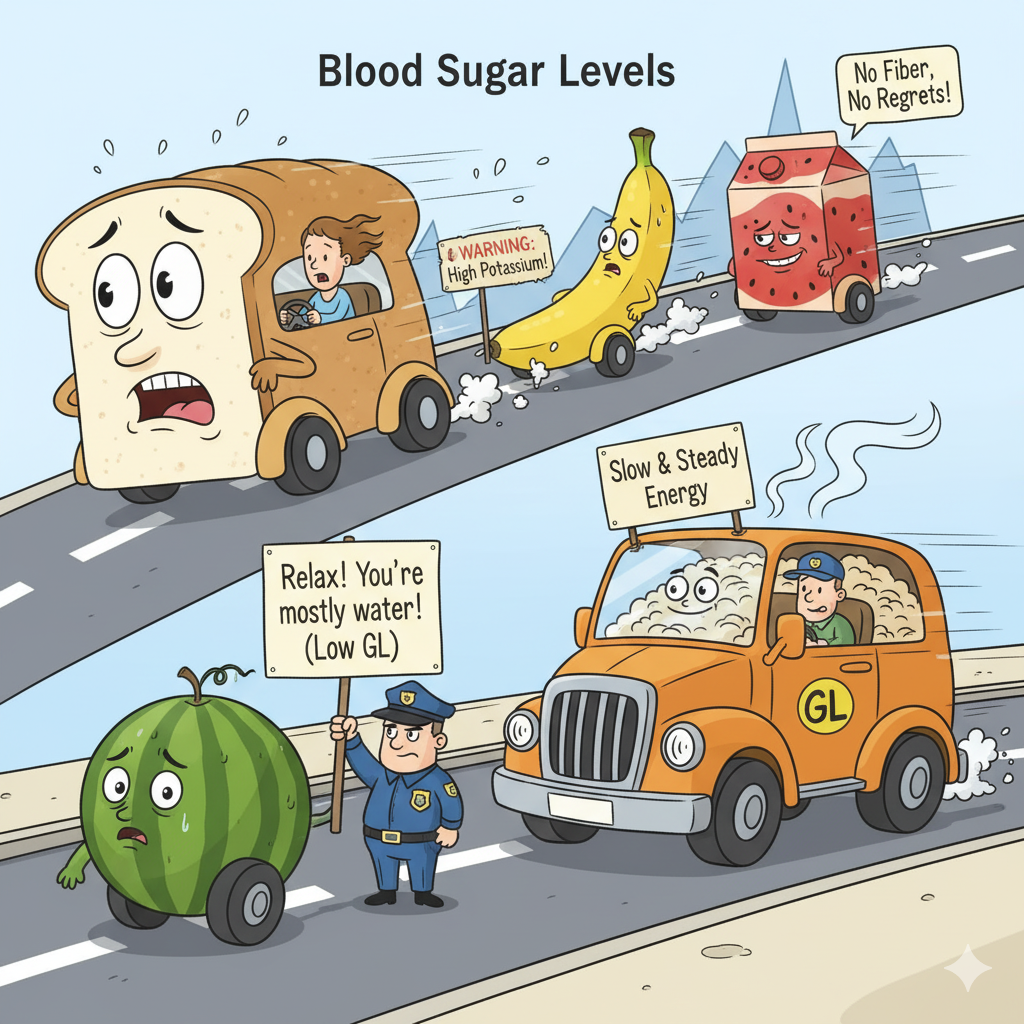
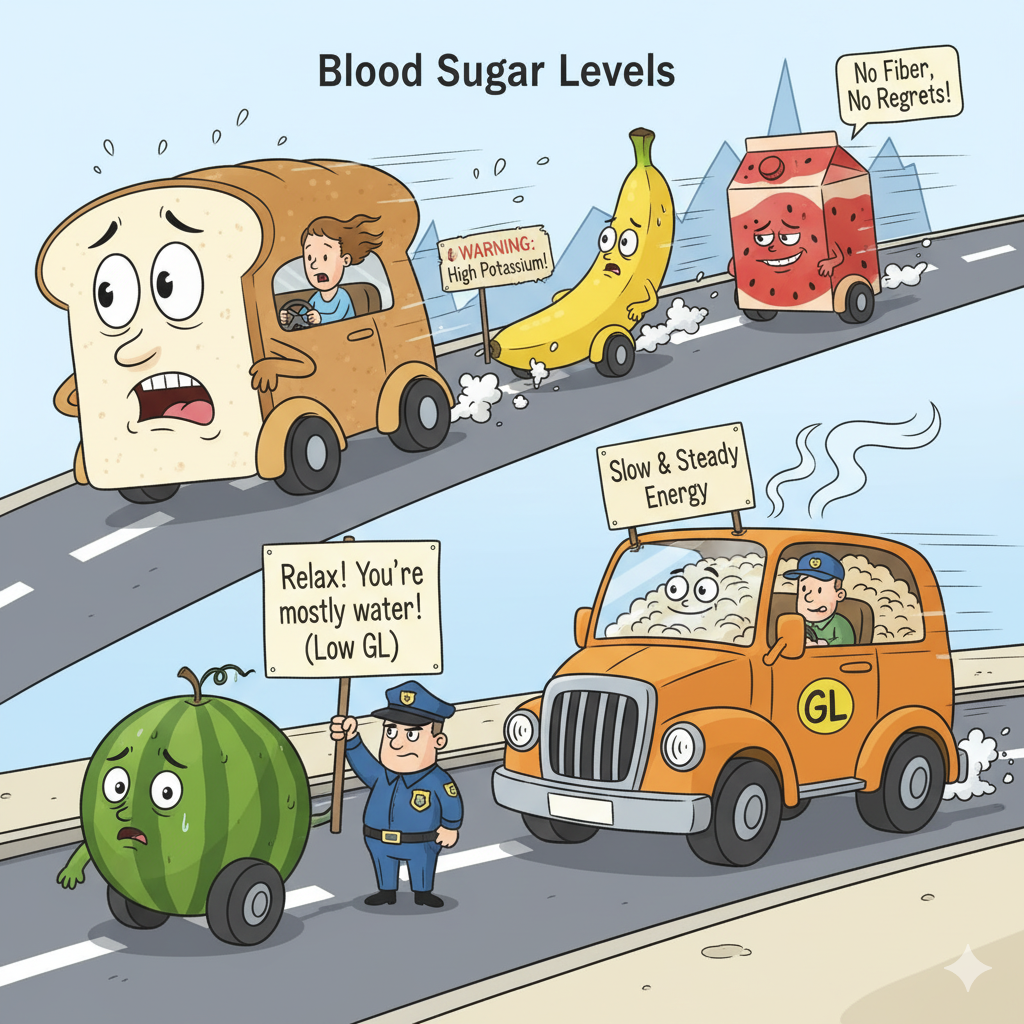
Imagine your blood sugar as a road 🚗 —
and each food you eat as a vehicle.
- Low GI foods drive slowly and steadily, releasing energy gradually.
- High GI foods zoom through quickly, causing a sudden spike (and crash) in your sugar levels.
💬 Scientific Definition:
Glycemic Index (GI) = The area under the blood glucose curve (after eating 50 g of available carbohydrate from that food)
÷
The area under the curve for 50 g of glucose (×100).
So, Glucose = 100 (the reference).
Other foods are compared against it.
📊 Classification of Foods by GI
| Category | GI Range | Examples |
|---|---|---|
| Low GI (≤ 55) | Slow release | Most fruits, vegetables, whole grains, beans, milk |
| Medium GI (56–69) | Moderate release | Brown rice, chapati, sweet corn |
| High GI (≥ 70) | Rapid release | White rice, potato, bread, sugar, candy |
💬 Easy way to remember:
“The whiter the food, the higher the spike.”
Refined, polished, or processed foods usually have a higher GI because fibre is removed — the sugar hits your blood faster.
🧪 But Wait — GI Isn’t Just About What You Eat, But How You Eat It!
Here’s where it gets interesting.
The GI of the same food can change based on how it’s prepared, processed, or combined.
| Factor | Effect |
|---|---|
| Cooking time | More cooking → starch gelatinizes → higher GI |
| Fibre content | More fibre → slower digestion → lower GI |
| Fat and protein | Slow gastric emptying → lower GI |
| Acidity (lemon, vinegar) | Slows glucose release → lower GI |
| Ripeness | Riper fruit → more sugar → higher GI |
💬 Surprising Fact:
- Boiled potato has a GI around 50–60.
- Mashed or fried potato → GI can shoot up to 80–90!
- Because mashing and frying pre-digest the starch.
🍉 The Watermelon Confusion — A Sweet Lesson in Science
Here’s a fun paradox.
Watermelon has a high GI (~72) — so does that mean it’s bad?
Not really.
Because watermelon contains very little carbohydrate per serving — most of it is water! 💧
That’s why, despite a high GI, it raises your blood sugar very slightly.
So we need another concept — one that considers how much carbohydrate you actually eat.
That’s where Glycemic Load (GL) comes in.
⚖️ Glycemic Load — The Real-Life Version of GI
💬 Definition:
Glycemic Load (GL) =
(GI × amount of carbohydrate in one serving) ÷ 100
It tells you the total blood sugar impact of the food as you eat it.
| Category | GL Range | Meaning |
|---|---|---|
| Low | < 10 | Minimal sugar rise |
| Medium | 11–19 | Moderate |
| High | ≥ 20 | Strong sugar spike |
So, our watermelon story makes sense now:
- High GI (72)
- But low carb per serving (~6 g per 100 g)
→ GL = 4.3 → Low overall sugar impact ✅
💬 That’s why watermelon (whole fruit) is fine — but watermelon juice isn’t!
Juicing removes fibre, concentrates sugar, and increases both GI and GL.
🧠 Why GI and GL Matter for Health
These measures are not just for diabetics — they’re for everyone.
They help us understand:
Why we feel sleepy after white rice 🍚 but steady after brown rice 🌾
Why oats keep us full for hours 🥣
Why refined carbs make us hungry again so quickly 🍞
🌿 Benefits of Low GI/GL Diets:
- Prevent diabetes and obesity
- Improve cholesterol and triglycerides
- Enhance satiety (feeling of fullness)
- Reduce risk of heart disease
- Support better athletic performance (steady energy release)
🔬 Emerging Concepts Beyond GI and GL
🧪 1. Insulinemic Index
Some foods (like milk) have a low GI but still cause a large insulin response.
So scientists began measuring how much insulin a food triggers — not just blood sugar.
This is called the Insulinemic Index (II).
👉 It explains why protein-rich foods or dairy can still influence metabolism even if their GI is low.
🧫 2. Glycemic Response
This refers to the total blood glucose change after a meal, considering everything — food combination, gut microbiome, genetics, and even sleep.
It’s the holistic version of GI.
💬 Example: Eating white rice alone has a high glycemic response.
But eating it with dal, vegetables, and curd dramatically lowers the response because of protein, fibre, and probiotics.
So it’s not just about what you eat — but how you combine foods.
⚙️ 3. Personalized Glycemic Index (Next Frontier)
AI-based nutrition apps and glucose sensors now show that each person’s glycemic response to the same food can differ.
A banana may spike one person’s sugar, but not another’s — depending on their gut bacteria, stress, and insulin sensitivity.
This is the future of personalized diet planning. 🍌💡
🩺 Simple Rules to Remember
- Choose Low GI foods: Whole grains, legumes, fruits, vegetables, nuts.
- Combine foods wisely: Add protein, fat, or fibre to carbs to lower the GI of the whole meal.
- Avoid refined, overcooked, or sugary items.
- Eat fruits whole, not as juice.
- Remember: GI ≠ Calories. A food can be low in calories but high in GI, and vice versa.
📚 Quick Recap Table
| Concept | What It Means | Example |
|---|---|---|
| GI | Speed of sugar rise | White rice (high), oats (low) |
| GL | Total sugar impact per serving | Watermelon = high GI, low GL |
| II (Insulinemic Index) | Insulin response | Milk = low GI but high II |
| Glycemic Response | Real-world blood sugar behavior | Dal + rice = lower response than rice alone |
💬 Let’s See How Much You Learnt
Question (Application-Based):
A diabetic patient asks whether they should stop eating watermelon because it has a high GI.
How will you explain this scientifically?
Answer:
✅ Watermelon has a high GI but very few carbohydrates per serving — so its Glycemic Load is low.
Eating it in moderation as whole fruit is fine.
However, avoid watermelon juice, as it lacks fibre and increases both GI and GL.
🌟 In Short
The Glycemic Index teaches us that not all carbohydrates are created equal.
Some walk slowly, some run fast — and some, like watermelon, only pretend to be fast! 🍉
The goal isn’t to avoid carbs — it’s to choose the ones that work with your body, not against it.