
After reading this, you will understand:
- What is PPBS in simple words.
- Why PPBS is used in health planning.
- How traditional budgeting works (and why it needs change).
- What is the Zero Budget Approach.
- How PPBS and Zero Budget Approach are linked.
- Real-life examples from the health system.
Let’s Begin with a Simple Situation
Imagine you are in charge of a district health office.
You have limited funds, limited staff, and many programs —
like maternal health, immunization, malaria control, and school health.
Your main question is:
“How can I use these limited resources in the best possible way to achieve my health goals?”
That’s where the Planning–Programming–Budgeting System (PPBS) comes in.
What is PPBS?
Planning–Programming–Budgeting System (PPBS) is a scientific method used in health planning to help decision-makers:
- Plan what they want to achieve (the goals).
- Program how they will achieve it (the activities).
- Budget how much money and resources each activity will need.
So, PPBS connects planning, programming, and budgeting step by step — to make sure every rupee, staff member, and resource is used most effectively.
💬 In simple words:
PPBS = Plan → Program → Budget → Achieve.
🧠 Example (District Health Office)
Let’s say your district wants to reduce maternal mortality.
- Planning: Decide the goal — “Reduce MMR by 20% this year.”
- Programming: Choose activities — training midwives, ensuring 24×7 delivery services, antenatal care, health awareness.
- Budgeting: Allocate funds to each activity according to priority.
By linking these three — you get a clear picture of what you want to achieve, how you’ll do it, and what it will cost.
How PPBS Works Step-by-Step
| Step | What You Do | Example |
|---|---|---|
| 1. Planning | Decide your objectives | “Reduce anemia in adolescent girls.” |
| 2. Programming | Choose activities to achieve it | Iron–folic acid tablets, health education, deworming. |
| 3. Budgeting | Allocate resources to each activity | ₹2 lakh for IFA tablets, ₹50,000 for awareness drives. |
| 4. Evaluation | Review if money and programs met objectives | Did anemia levels really go down? |
💡 Why PPBS Is Useful in Health Planning
- Ensures efficient use of limited resources.
- Helps compare which programs are most cost-effective.
- Prevents wastage of funds on unimportant activities.
- Encourages accountability and transparency.
- Helps set clear priorities among multiple programs.
But Wait — How Was Budgeting Done Before?
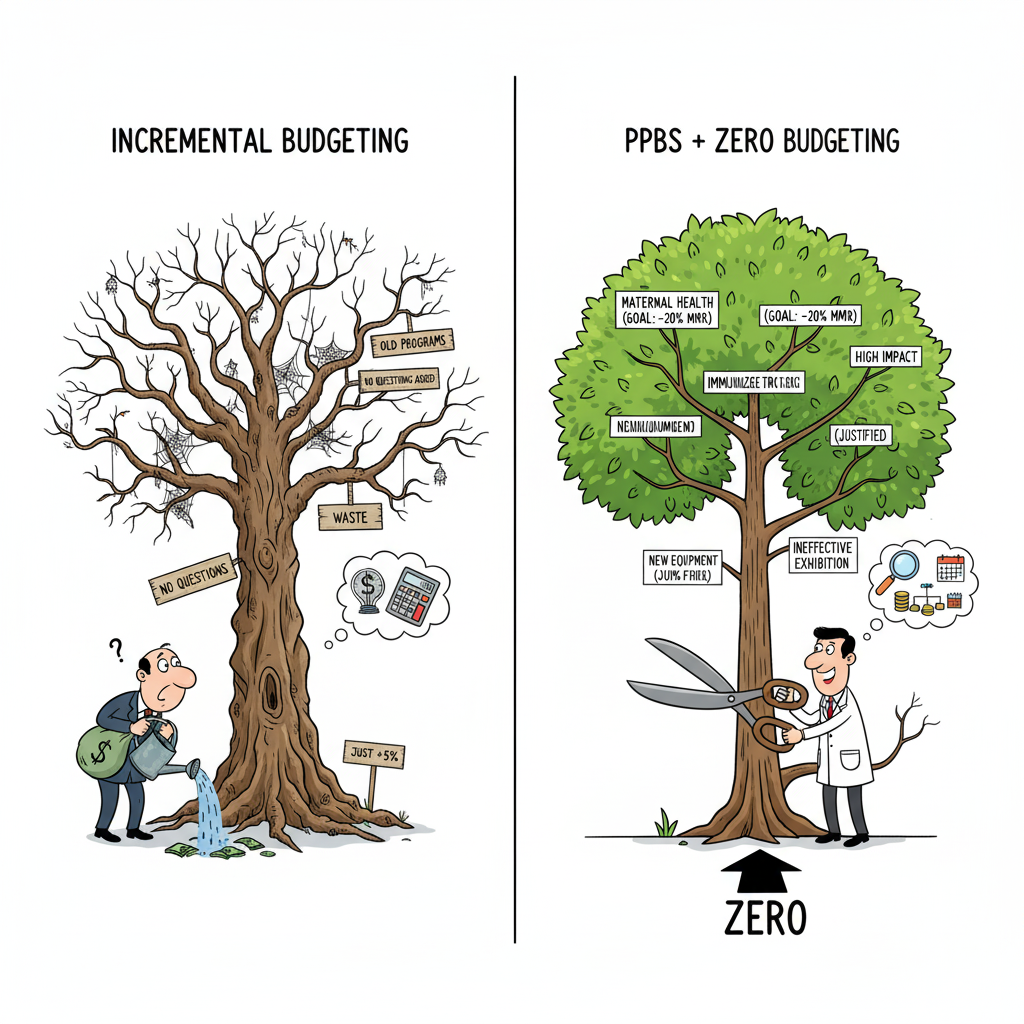
Before PPBS and Zero Budgeting, most health departments used Incremental Budgeting.
Every year, when preparing the budget, officials simply looked at last year’s numbers and said:
“We spent ₹10 lakh last year — let’s add 5% more this year for inflation.”
So, the previous year’s spending became the base,
and the new year’s budget was prepared by just adding or subtracting a little.
📘 This is called Incremental Budgeting,
because you just “increase” or “decrease” last year’s figures without reviewing their usefulness.
Problems with Incremental Budgeting
❌ Old, ineffective programs keep getting money every year.
❌ No one questions whether a program is still needed.
❌ Funds are wasted on low-impact activities.
❌ New, important programs often don’t get funds.
Over time, the health budget becomes like an overgrown tree 🌳 —
full of old branches that no one trims.
The Solution — The Zero Budget Approach (ZBA)
To fix this, planners proposed a new method:
“Let’s not carry forward last year’s budget automatically.
Let’s start from zero each year and justify every rupee spent.”
This is the Zero Budget Approach (ZBA).
In Simple Words
Zero Budget Approach = Start from zero and justify every expense.
Every department begins its budget process from zero —
no one gets money automatically unless they prove the need for it.
It’s like pressing the reset button 🔁 on your budget —
you start fresh, review all your programs, and allocate money only where it’s truly needed and effective.
Real-Life Example
Last year your PHC had ₹5 lakh:
- ₹1 lakh for School Health Exhibitions 🎨
- ₹3 lakh for Immunization 💉
- ₹1 lakh for Maternal Health 👩🍼
This year, instead of repeating the same, you check:
- The exhibitions had very little impact → maybe not needed.
- Immunization improved coverage → continue and increase funds.
- Maternal health needs new equipment → allocate more.
Now you redesign the whole budget from zero —
giving money only where it truly matters.
✅ That’s Zero Budgeting in action — smart, logical, and efficient.
🔗 Connection Between PPBS and Zero Budget Approach
The Planning–Programming–Budgeting System (PPBS) uses the Zero Budget Approach as its foundation.
PPBS helps you:
- Plan your goals (e.g., reduce maternal mortality).
- Program your activities (e.g., antenatal care, staff training).
- Budget from zero each year — based on results and priorities, not past habits.
Thus, the Zero Budget Approach ensures that PPBS stays efficient, relevant, and accountable.
Quick Health Example
At a District Hospital:
- Plan: Improve child health.
- Program: Immunization, nutrition counselling, newborn screening.
- Budget: Start from zero — fund only those activities that showed impact last year.
👉 Result: Better use of money, improved outcomes, and no waste.
In Short
| System | Meaning |
|---|---|
| Incremental Budgeting | “Last year + a little more.” |
| Zero Budgeting | “Start from zero and justify everything.” |
| PPBS | “Plan + Program + Budget wisely using Zero Budget Approach.” |
💬 Let’s See How Much You Learnt
Question:
Last year your PHC spent ₹10 lakh. This year you’re asked to plan again. Instead of copying last year’s budget with small changes, you start from zero, evaluate each program’s success, and fund only those that show results.
👉 What approach are you using?
Answer:
✅ The Zero Budget Approach — starting from zero, re-evaluating each activity, and allocating funds only to effective programs. This forms part of the PPBS system.