
After reading this, you will understand:
- What is Work Sampling in simple words.
- Why it is used in hospitals and health centers.
- How it is done (step-by-step).
- Real examples from the health field.
- Its advantages and limitations.
🌍 Let’s Begin with a Simple Situation
Imagine you are a Medical Officer at a District Hospital.
You notice that sometimes your nurses are overworked,
while at other times, some seem free or waiting for tasks.
You wonder —
“Are we using our staff efficiently? Do we really need more nurses,
or just better planning of their time?”
You could sit and watch everyone all day 😅 — but that’s not practical.
So instead, you decide to observe staff at random times during the day and record what they’re doing —
whether they’re giving injections, doing paperwork, assisting doctors, or idle.
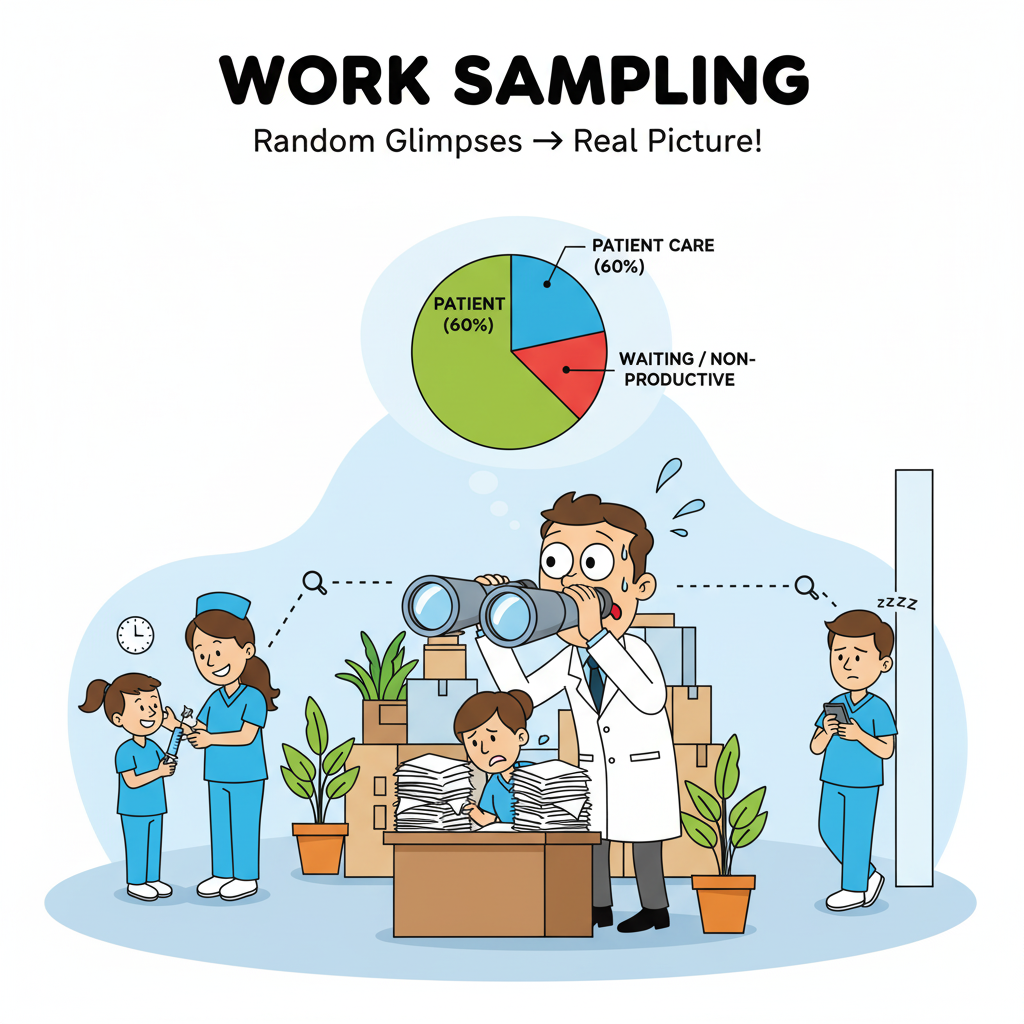
After many observations, you find that 60% of time is spent on patient care,
25% on documentation, and 15% on waiting or non-productive tasks.
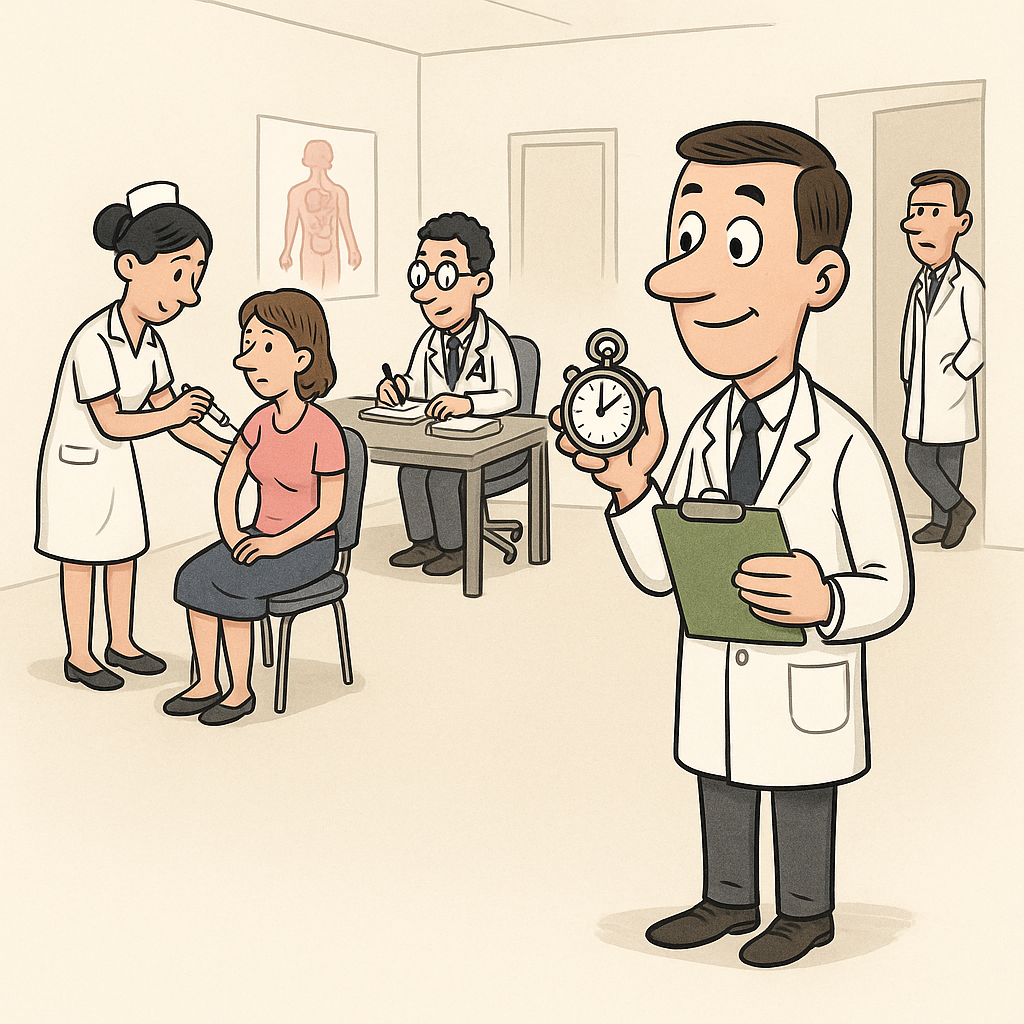
👉 This simple technique of observing work at random intervals is called Work Sampling.
💡 What is Work Sampling?
Work Sampling is a method used to study how time is being used by individuals or groups in a workplace —
by observing their activities at random intervals over a period of time.
It helps to find out:
- How efficiently time is being utilized.
- What proportion of time is spent on different tasks.
- Whether the workload is balanced among staff.
💬 In Simple Words:
Work Sampling = Watching work at random times to see how time is actually being used.
⚙️ Steps in Work Sampling
Let’s understand the process step-by-step 👇
| Step | What You Do | Example |
|---|---|---|
| 1. Define the purpose | Decide what you want to find out | “Are nurses spending too much time on paperwork?” |
| 2. Select the group or person | Choose whose work you will study | Nurses in OPD or ward |
| 3. Define activities clearly | List what activities you’ll observe | Direct patient care, record keeping, idle time, etc. |
| 4. Decide observation method | Choose random times to observe | Every 20 minutes for 5 days |
| 5. Record observations | Note down what each person is doing at that moment | Nurse giving injection / filling register / talking to relatives |
| 6. Analyze data | Calculate % of time spent on each activity | Patient care = 60%, paperwork = 25%, idle = 15% |
| 7. Take action | Identify inefficiencies and improve workflow | Simplify record-keeping or adjust nurse shifts |
🩺 Example from the Health Field
Let’s say a hospital administrator wants to check how doctors in the outpatient department (OPD) spend their time.
After observing them at random intervals, results show:
- 50% of time → seeing patients
- 30% → filling forms and records
- 10% → talking to staff
- 10% → waiting or idle
💡 Based on this, the hospital decides to:
- Introduce data entry assistants to handle paperwork.
- Allow doctors to focus more on patient care.
Result → Improved efficiency and shorter waiting times for patients.
📊 Why Work Sampling Is Important
✅ Helps in workload assessment — whether staff are under- or over-utilized.
✅ Improves staff planning and duty distribution.
✅ Highlights non-productive time and bottlenecks.
✅ Aids in decision-making — e.g., “Do we need more nurses or just better task division?”
✅ Provides quantitative evidence for administrative changes.
⚠️ Limitations
❌ Time-consuming if done on large staff numbers.
❌ Observer bias — people may change behavior when watched.
❌ Requires multiple observations to get accurate data.
❌ Not useful for very short or unpredictable tasks.
🧩 In Short
| Concept | Simple Meaning |
|---|---|
| Work Sampling | Observing work at random intervals to find out how time is used |
| Purpose | To improve efficiency and resource utilization |
| Used for | Doctors, nurses, lab techs, admin staff |
| Helps in | Staff planning, reducing idle time, improving service delivery |
🧠 Easy Memory Trick
Work Sampling = “Random Glimpses → Real Picture”
You don’t need to watch continuously — just small random checks show the bigger pattern.
💬 Let’s See How Much You Learnt
Question:
As a Medical Officer, you randomly observe nurses during different hours to see how much of their duty time is spent on direct patient care, documentation, and waiting.
You later analyze these observations to plan better staffing.
👉 What management technique are you using?
Answer:
✅ Work Sampling — a method of systematic observation at random intervals to measure how staff time is distributed among various activities.