
In this section, you will learn and be able to articulate:
The 5 Core Principles of PHC (your ESSENTIAL exam points).
The Practical Logic behind each principle, using real-world examples.
The ‘Why’: Why the simplest solutions (like ORS) are often the most powerful tools in public health.
Let’s start with a mind-blowing fact that ties directly into one of the principles: Appropriate Technology.
A child dies from diarrhea. The cure could be complicated surgery, or an expensive new drug, right? Wrong. The single most successful public health tool against diarrheal dehydration is the humble Oral Rehydration Solution (ORS).
Why is ORS the perfect example of Appropriate Technology?
Scientific: It works perfectly (it contains the right balance of glucose and salt).
Simple: Anyone can mix it with clean water.
Affordable: It costs pennies!
Accessible: You don’t need a doctor or a hospital to use it.
This simple packet of salt and sugar saves millions of lives because it perfectly fits the PHC model—it brings effective care directly to the people. This is the level of practical thinking we need to apply to all five principles!
Here are the five core principles of Primary Health Care (PHC), explained clearly with engaging examples for easy learning and good flow:
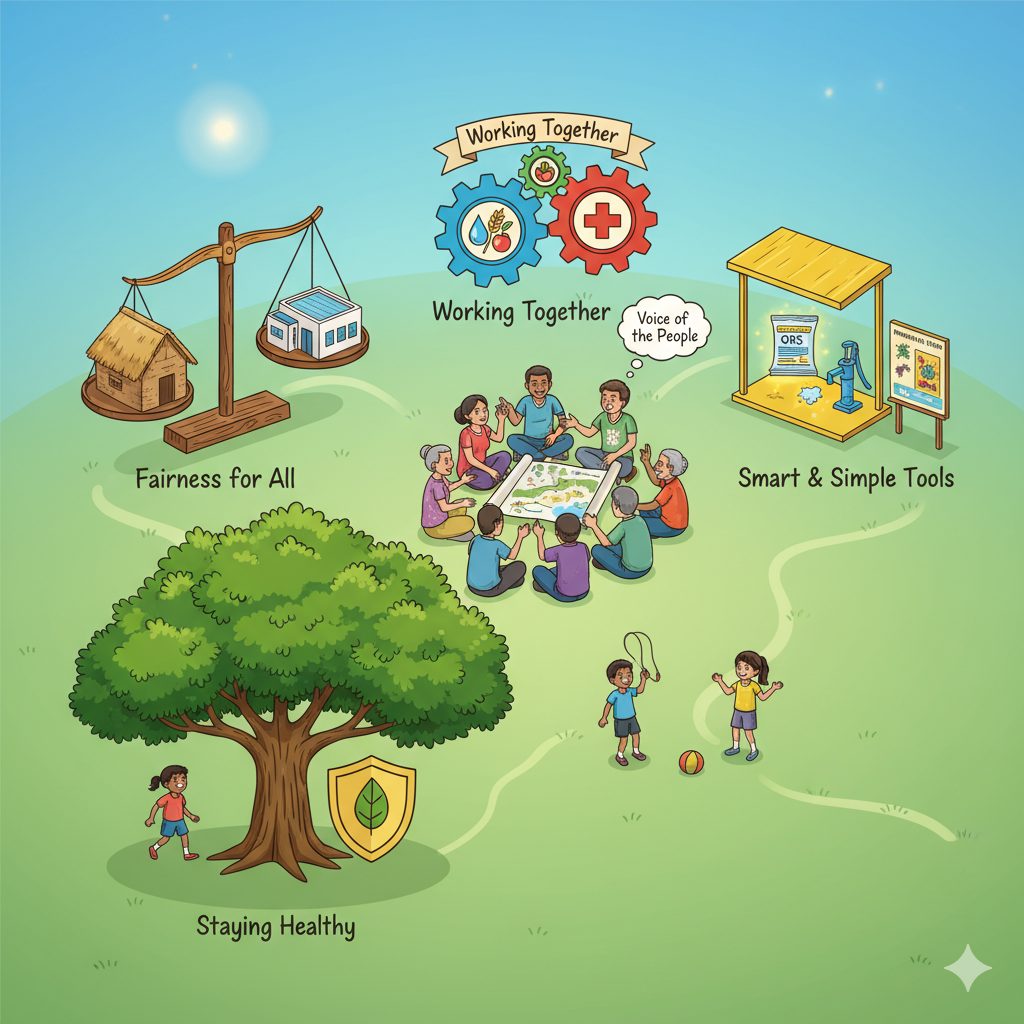
1. ⚖️ Equitable Distribution: Fairness, Not Just Equality
(guys!! This is the most important and most confusing principal…so i take the liberty to use extra words to explain it and make it easier for you)
Imagine you and your friend both need help to see over a tall fence to watch a cricket match.
1. Equality (Giving Everyone the Same)
- What it means: The coach gives everyone one small stool.
- The problem: If your friend is already tall and can see, the stool doesn’t help much. But if you are very short, that one small stool might still not be enough for you to see over the fence. You both got an equal amount, but it wasn’t fair.
2. Equity (Giving According to Need)
- What it means (PHC Principle): The coach looks at the situation and gives help where it’s actually needed.
- The Action:
- The tall friend gets no stool (they don’t need it).
- You, the shorter student, get two stools stacked up so you can see perfectly!
- The Outcome: Now, both you and your friend have the same result—you can both watch the match easily. The distribution was unequal (you got more), but the final opportunity was fair.
PHC in Simple Terms
In healthcare, Equitable Distribution means we must give more resources and help to the people who are currently starting from a disadvantage.
- Example: A remote village has no roads and very little money. A rich city has three good hospitals.
- Equity means: The government must spend more money building mobile health clinics and training local ASHA workers for the village so they get the same chance at good health as the people in the city.
Simply Put: Healthcare shouldn’t depend on your pincode or your bank account. We balance the scales by helping the disadvantaged more, ensuring everyone gets a fair chance to be healthy.
2. Community Participation (Involvement and Ownership) 🧑🤝🧑
Health programs are most effective when people themselves are involved in planning, implementing, and evaluating them. Participation means listening to the community’s needs and empowering them to take responsibility for their own health.
Simply Put: Health plans should be with the people, not done to the people.
The Role of Doctors: As doctors, you must act as facilitators, not dictators. You guide the community, but the final strategy must reflect their acceptance and local needs.
Real-World Example: The success of village-level Self-Help Groups (SHGs) or the utilization of ASHA workers stems from this principle. Since the ASHA worker is from the same village, people trust her advice and the program gains local ‘ownership.’
3. Intersectoral Coordination (Partnership and Teamwork) 🔗
This principle recognizes that health is determined by factors outside the health sector. Clean water, sanitation, food, education, and housing are critical. Therefore, the Health Department must collaborate (coordinate) with other departments.
Simply Put: No single ministry can solve a complex health problem alone.
The Big Picture: A disease like Tuberculosis (TB) needs the Health Department (treatment), but also the Social Welfare Department (nutrition support) and the Housing Department (better ventilation to stop spread).
Real-World Example: Successful campaigns against Malnutrition involve the Health Ministry (vitamins), the Education Ministry (mid-day meals), and the Public Works Department (safe drinking water).
4. Appropriate Technology (Effective, Simple, and Affordable) 🛠️
As introduced before, technology used in PHC must be scientifically valid but also acceptable to the community, cheap, and easy to use. It should be sustainable in low-resource settings.
Simply Put: Use the best tool that the community can afford and operate easily. Avoid unnecessary complexity.
Key Distinction: “Appropriate” doesn’t mean “second-best.” It means the most suitable solution for that context.
Real-World Example: The invention of the Oral Rehydration Solution (ORS) is the textbook example. It saves millions of children globally, not with high-tech equipment, but with a simple, affordable mix of salt and sugar that requires no specialist.
5. Focus on Prevention (Prioritizing Health Over Illness) 🛑
PHC shifts the focus from curative care (treating sickness) to preventive and promotive care (keeping people healthy). The bulk of PHC resources should be spent on stopping diseases before they start.
Simply Put: An ounce of prevention is worth a pound of cure.
The Main Activity: The local PHC must be a hub for Immunization (vaccines), Health Education (hygiene, sanitation), and early detection of disease (antenatal checkups).
Real-World Example: Instead of just treating cases of Typhoid every summer, a PHC prioritizes testing water sources and educating villagers on boiling water to prevent the outbreak entirely.
Lets see what you have Learnt
The Scenario
Dr. Priya, a newly appointed District Medical Officer (DMO), is leading a program to control Anemia in adolescent girls in a remote, predominantly tribal district where iodine deficiency is also endemic. She observes the following challenges:
- Iron and Folic Acid (IFA) tablets are distributed free, but compliance is very low because the girls dislike the taste and often forget to take them.
- The nearest hospital with diagnostic facilities is 100 km away, making regular checkups for severe anemia impossible for most.
- The DMO finds that the main cause of severe anemia is not just diet, but also hookworm infestation, which requires improved sanitation (toilets) and clean water.
The Question
Identify three different principles of Primary Health Care (PHC) that are being violated or need to be strengthened to make Dr. Priya’s program successful. For each principle, suggest one specific, practical intervention.
Application Answer: PHC in Action ✅
Dr. Priya’s program highlights key areas where the theoretical principles of PHC must be practically applied to overcome real-world hurdles.
1. Principle Violated/Needs Strengthening: Appropriate Technology 🛠️
Violation: The current IFA tablets (the “technology”) are not socially acceptable due to taste, leading to low compliance. An inappropriate technology fails even when given free.
Intervention: Switch the delivery mechanism to a more acceptable form, such as Weekly Iron and Folic Acid Supplementation (WIFS) programs administered in schools under supervision, or replace the tablets with iron-fortified foods (e.g., iron-fortified salt or flour) which bypass the “compliance” issue entirely.
2. Principle Violated/Needs Strengthening: Equitable Distribution ⚖️
Violation: Access to diagnostic and curative services (checking for severe anemia) is extremely poor due to the 100 km distance. This creates a significant geographical barrier, meaning healthcare is not distributed equally to the remote population.
Intervention: Introduce a Mobile Health Team that visits remote villages monthly, equipped with point-of-care testing (POCT) devices (like a portable hemoglobinometer) to provide on-the-spot screening and treatment for severe cases, thus bringing the service closer to the people.
3. Principle Violated/Needs Strengthening: Intersectoral Coordination 🔗
Violation: Dr. Priya has identified the root cause as hookworm and sanitation problems, which fall under the purview of the Water and Sanitation/Rural Development Departments. Focusing only on giving tablets (the Health Sector’s job) will fail to eliminate the problem.
Intervention: Establish a formal coordination mechanism with the Rural Development Department to accelerate the construction of household toilets (under programs like Swachh Bharat) and ensure the supply of clean drinking water, tackling the underlying determinants of the disease.